
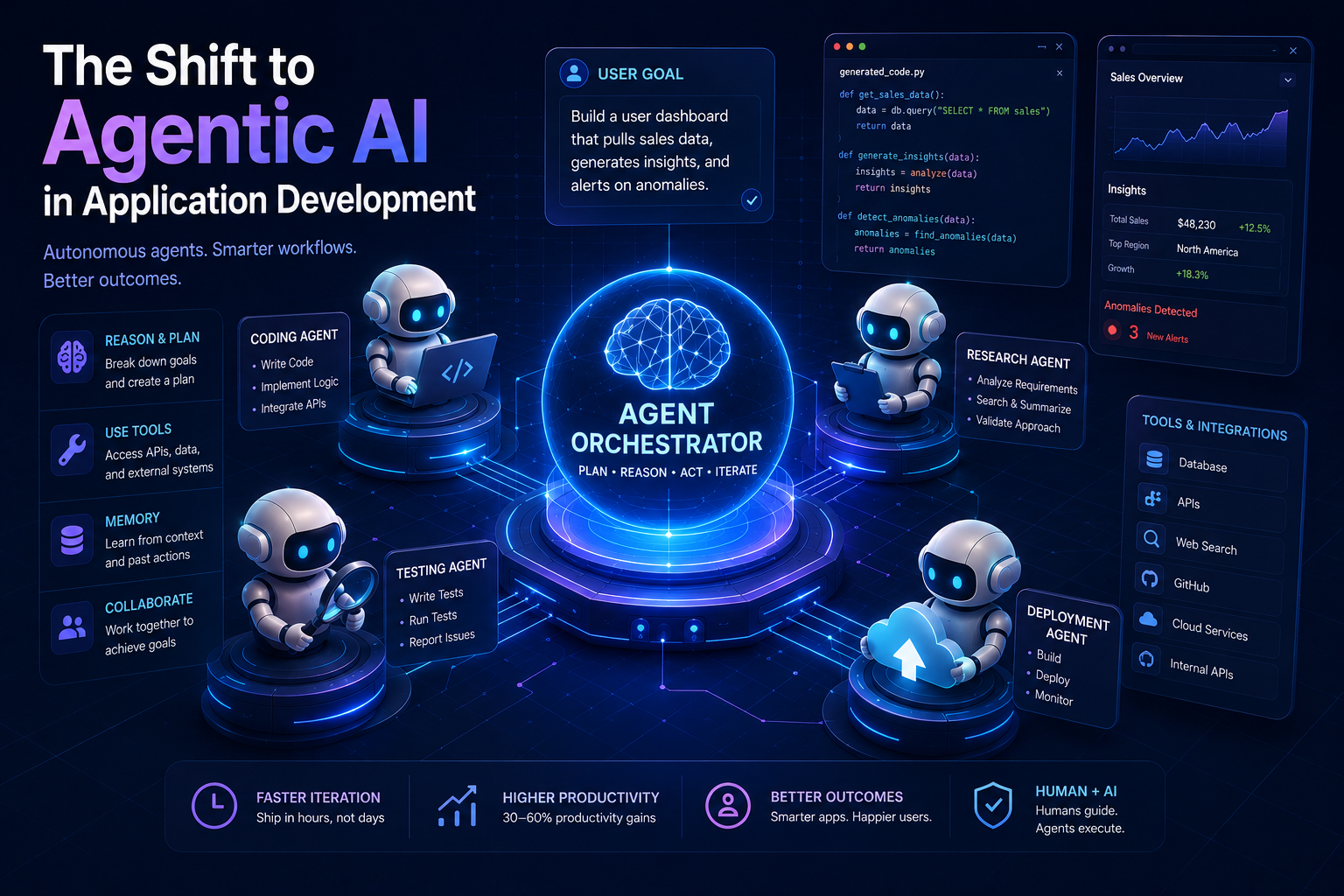
The Shift to Agentic AI in Application Development
How autonomous agents are changing workflows, automation, and user experiences in 2026
Agentic AI represents one of the most significant shifts in software development since the rise of cloud computing. While generative AI helped us write code and content faster, agentic AI enables systems to plan, reason, act, and iterate toward goals with minimal human supervision.
In 2026, autonomous agents are moving from experimental demos to production workflows across web and application development. They’re reshaping how we build, maintain, and interact with software.
What Exactly Is Agentic AI?
Traditional AI (like chatbots or code completion tools) responds to prompts. Agentic AI goes further: it perceives its environment, sets sub-goals, uses tools (APIs, databases, browsers, code interpreters), makes decisions, and executes multi-step plans autonomously or semi-autonomously.
Key capabilities include:
- Reasoning & Planning: Breaking complex tasks into steps (often using frameworks like ReAct or reflection loops).
- Tool Use: Interacting with external systems (e.g., GitHub, databases, web search, or your own APIs).
- Memory: Short-term (conversation context) and long-term (vector stores or knowledge graphs).
- Multi-Agent Collaboration: Teams of specialized agents (e.g., researcher + coder + tester) working together.
This turns AI from a helpful assistant into a capable colleague or even an autonomous worker.
How Agentic AI Is Transforming Developer Workflows
In 2026, the biggest impact is visible in software engineering itself:
- From Coding to Orchestration: Developers spend less time writing boilerplate and more time defining high-level requirements, reviewing outputs, and handling edge cases.
- Multi-Agent Pipelines: A “product agent” interprets requirements, a “coding agent” implements, a “testing agent” validates, and a “deployment agent” pushes to staging.
- Faster Iteration: Tasks that once took days now complete in hours, with reported productivity gains of 30-60% in many teams.
Practical Example in Web/App Development:
You describe: “Build a user dashboard that pulls sales data, generates insights, and alerts on anomalies.”
An agentic system can analyze requirements, query your database schema, generate frontend components and backend endpoints, write tests, and deploy a preview.
Impact on Automation and Business Workflows
Agentic AI excels at dynamic, adaptive automation that traditional scripts and RPA tools struggle with:
- Internal tools that monitor systems, triage support tickets, or optimize cloud costs in real time.
- Customer-facing experiences like personalized shopping agents or intelligent support bots.
- SaaS features such as subscription management agents and self-healing data pipelines.
In web applications, this means shifting from static forms and dashboards to proactive, goal-oriented interfaces.
Building Agentic Features: Tools and Frameworks (2026 Landscape)
Popular options for web and application developers include:
- LangGraph / LangChain — Excellent for stateful, production-grade workflows with strong Python integration.
- CrewAI — Great for role-based multi-agent teams and fast prototyping.
- AutoGen (Microsoft) — Strong for collaborative agents.
Getting Started Tip: Begin small. Integrate an agent that automates a repetitive task in your existing app (e.g., report generation or bug triage) using LangGraph + your APIs. Focus on guardrails, observability, and human-in-the-loop approvals early.
Challenges and Considerations
- Reliability & Hallucinations: Agents can fail creatively — implement robust evaluations, retries, and fallback mechanisms.
- Security & Governance: Tool access, permissions, data privacy, and prompt injection risks are critical.
- Cost & Observability: Monitor token usage and long-running agents closely.
- Human Role Evolution: The bottleneck shifts to high-judgment tasks like architecture, ethics, and creative direction.
The Future of User Experiences
By embedding agentic capabilities, applications become more intuitive and powerful. Users move from clicking through menus to conversing with goal-oriented systems that understand context across sessions and tools.
Conclusion: Prepare Now
The shift to agentic AI isn’t about replacing developers — it’s about amplifying what we can achieve. Teams that learn to orchestrate agents effectively will ship faster, build smarter features, and deliver superior user experiences.
At icuinternet.com, we’re already experimenting with agentic patterns in client projects. If you’re building web or application solutions and want to explore how agentic AI can fit your stack, feel free to reach out.
What’s your take? Are you using agents in your workflows yet? Share in the comments below.
Stay tuned for follow-up posts with practical tutorials (e.g., Building Your First Agentic Feature with LangGraph).